How to Find Your Purpose in Life
A Guide to Living On Purpose in Midlife and Beyond
By Chip Conley
The short answer:
If you’re trying to figure out how to find your purpose in life, searching harder rarely works. Nearly 50 years of research shows that the people searching hardest for meaning report having the least of it.
Purpose tends to show up after you act: when you talk honestly with one person you trust, use what you’re good at to help someone, and stop doing what no longer fits. In midlife, a better question than “What’s my calling?” is “How can I be useful now?”
The seven practices below are where to start.
In this guide
- Isolation, Invisibility, and Loss of Purpose
- What Is the Purpose of Life? Why It's a Verb, Not a Noun
- Big "P" and Small "p" Purpose
- Why a Sense of Purpose Runs Out in Midlife
- Feeling Lost in Life: The Signs Most of Us Miss
- Purpose Anxiety: Why Searching for It Makes It Worse
- Does a Sense of Purpose Help You Live Longer?
- Ikigai: The Four Questions, and Why Your Answers Change
- Seven Practices That Worked for Me
- Finding Your Purpose vs. Living On Purpose
- Three People Who Found Theirs in Midlife
- Four Ways to Start This Week
- Common Questions
Up to 91% of people report feeling anxious about not knowing their purpose. That’s from Larissa Rainey’s research [1] at the University of Pennsylvania, where she named the feeling “purpose anxiety.”
So if you’re reading this with a knot in your stomach because everyone else appears to have worked out what their life is for, you’ve misread the room. They just aren’t talking about it at dinner.
I spent the back half of my forties in that knot. For 24 years, my answer to “so what do you do?” was CEO. Then the Great Recession kicked my ass, I sold my hotel company at the bottom of the market, my relationship ended, and I lost five male friends to suicide before I turned 52.
When my role as CEO went away, so did my purpose. This revealed something I would rather not have known: it was never my purpose. It was a business card.
*If you or someone you know is struggling or in crisis, help is available. You can call or text 988 or chat at 988lifeline.org in the U.S. and Canada.
So I did what you’re very likely doing right now. I went looking for a replacement, and it made me feel worse. Then I found the research, which says the searching itself is the problem.
You aren’t failing to find your purpose; you’re suffering because “finding” is the wrong verb.
Purpose isn’t a possession you locate and hold up for others to admire. It’s a way of living – your days spent on what you actually care about, in small ordinary ways, most of the time. At MEA, we don’t teach people to have a purpose. We teach them to live on purpose. Or as I put it a few years back: you can’t be the noun if you don’t do the verb.
Part 1
What Purpose Is, and Why We Lose It
You've been hunting the wrong kind of thing. Here is what purpose is, why it goes missing on a schedule nobody warns you about, and why searching harder makes it worse.
Isolation, Invisibility, and Loss of Purpose: The Three Fears Researchers Keep Hearing
A couple of Christmases ago, I read an academic paper instead of the latest Stephen King novel. (I know. I’m a delight at parties.)
It was “Emerging Elderhood: Transitions from Midlife” [2], published in the Clinical Social Work Journal by Karen Skerrett, who later taught with us in Santa Fe, and her colleagues Marcia Spira and Jasmine Chandy. They’d interviewed people crossing out of midlife, and three fears kept coming up:
Isolation. Invisibility. Loss of purpose.
We hear the same three in our workshops every week.
The thing is, these aren’t separate problems. They’re one problem wearing three coats.
Isolation is what happens when the work that connected you to people ends. Invisibility is what happens when the role that made you legible to strangers ends. Both are downstream. Loss of purpose is the load-bearing wall: pull it out and the other two come down with it.
This is good news: it means you only have to repair one thing.
What Is the Purpose of Life? Why It’s a Verb, Not a Noun
Purpose works best as something you do, not something you own. It’s a way of living, not a prize you find.
I love this quote from psychiatrist David Viscott:
The purpose of life is to discover your gift. The work of life is to develop it. The meaning of life is to give your gift away.
(Note: These lines are by psychiatrist David Viscott, though they are frequently misattributed to Pablo Picasso.)
Look at the verbs: discover, develop, give.
Somewhere in the last century we turned purpose into a noun – a thing you own. You hear it in how people talk: “I can’t find my purpose,” as though it were a handbag left in a gas station bathroom.
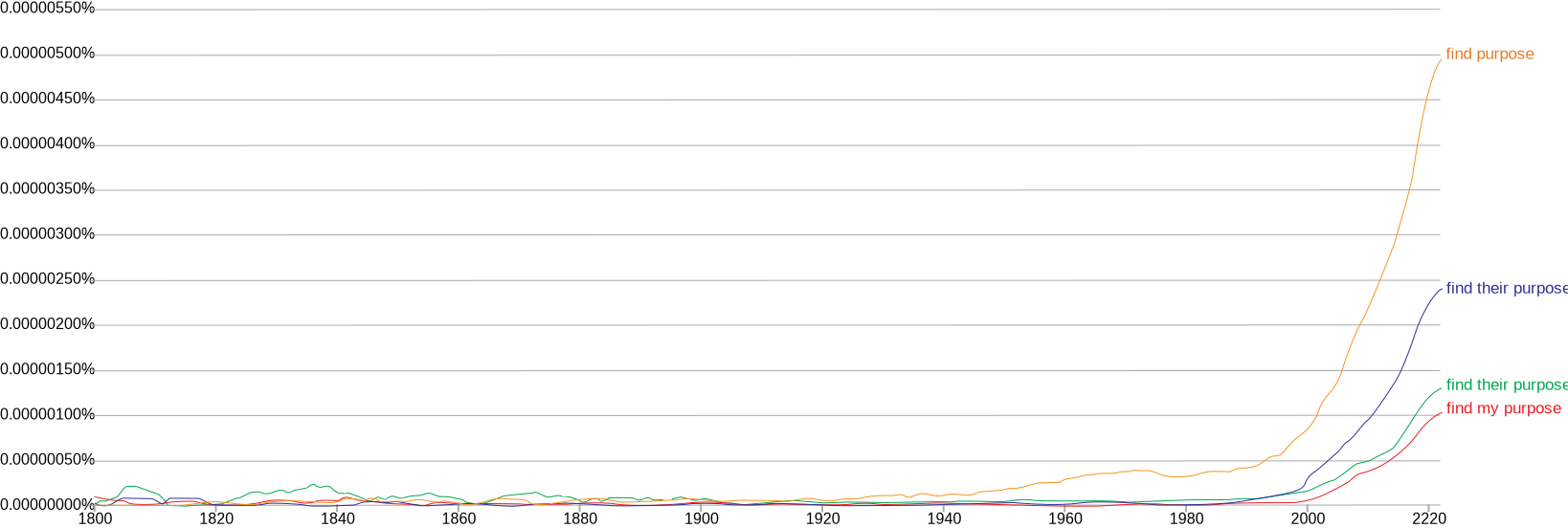
You can watch it happen in print. For most of the last century, books barely used the phrase “find your purpose.” Around 2000, it took off, along with “find my purpose” and “find their purpose.”
The challenge is, if purpose is an object, that means you can lose it. The job ends, or the kids move out, and you spend years hunting for something that can’t be replaced. But if purpose is something you do, even if you stop doing it, you can start again tomorrow.
It works a lot like happiness. Chase it, and it slips away. Get busy with something that matters, and it tends to show up.
Purpose: The Noun vs. The Verb
- A thing you own
- Can be lost
- Must be found
- Shown to others
- Singular
- Permanent
- A way of being
- Can’t be lost
- Practised daily
- Pointed at others
- Plural
- Moves
My friend Richard Leider, MEA faculty and author of The Power of Purpose, has spent 50 years studying purpose. He says:
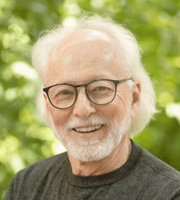
Purpose is not a role or a goal; it is an aim and a mindset. To awaken, to grow, to continually give, and to make a difference to others, that's why we are here. It's who we bring to what we do.
Stanford psychologist William Damon puts it in research terms: purpose is something that matters to you and makes a difference to someone beyond you [3]. That second part is what separates a purpose from a personal goal.
Psychology also recognizes purpose as a core part of well-being. When Carol Ryff at the University of Wisconsin built the standard measure of psychological well-being, she made purpose one of six components [4], alongside autonomy, growth, relationships, self-acceptance, and mastery.
Purpose matters, but it’s only one part of a life well lived, which should take some pressure off if you’re still searching for yours.
Big “P” and Small “p” Purpose
“Big P” purpose is a grand, one-sentence life mission. “Small p” purpose is the everyday things people already thank you for, and it’s the one most of us overlook.
Leider identified two kinds of purpose.
“Big P” purpose is the LinkedIn version, the defining statement about who you are. Most of us imagine finding it in a single moment of clarity, then dedicating our entire lives to it.
“Small p” purpose is what people already come to you for, and thank you for without you noticing. It explains why your niece calls you for advice instead of her mother.
Almost all of us hunt the “big P” while the small one goes unrecognized. And yet as Leider points out, 1,440 minutes in a day means 1,440 chances to be purposeful, not one single moment to define your existence.
Your purpose might be mentoring the new hire, coaching your town’s Little League team, or being the friend everyone calls in a crisis. It can change over time, and you can have more than one.
Big “P” vs. Small “p” Purpose
- On your LinkedIn profile
- Announced at reunions
- Arrives whole
- Permanent
- One sentence explains your life
- What people already thank you for
- Why your niece rings you
- 1,440 chances a day
- Changes
- You’re allowed several
Big “P” / small “p” purpose concept: Richard Leider
If that feels like lowering the bar, good. The bar was set so absurdly high that most people gave up and called it a midlife crisis.
Why a Sense of Purpose Runs Out in Midlife
A lack of purpose in midlife usually comes from one thing: your purpose was tied to a role, such as a job title, and roles end.
Whatever carried you through the first half was almost certainly a role. Founder. Surgeon. Mother of small children. The one who got out. Roles hold a great deal of weight, and they work beautifully – until they end.
Roles end on a timetable nobody publishes. The company sells, the kids leave, or the industry moves on without consulting you. When it happens, it feels like a personal failure rather than a scheduled life stage.
Part of that stems from running a script you never chose. At MEA, we call these Success Scripts, the definition of success handed to you in childhood that you have never audited. You received it before you could read, and you may still be performing it at 55 for an audience that left the theater years ago.
Arthur Brooks, the Harvard social scientist, put it this way when he joined me on the Midlife Chrysalis podcast:
"This is the mentality not of adding brushstrokes to the canvas of your life, but chipping away the marble that is the beautiful sculpture that's you. First curve success is adding brushstrokes. Second curve success is chipping away."
The Skerrett paper includes a woman of sixty-three, recently widowed and increasingly alone, who’d been socially and politically active her whole adult life. She wasn’t frightened by a bleak picture of her future, but by the fact that she couldn’t picture it at all.
I’ve met a hundred versions of her. I’ve been one. My own sense of purpose ran out at 47, right on schedule.
I was a fluent performer. I call the condition “successism,” a societal story that becomes your own without your noticing, the way consumerism or ageism does. My identity merged with my company’s results. It worked, it was toxic, and I couldn’t see it while it was happening.
Feeling Lost in Life: The Signs Most of Us Miss
The signs you’ve lost your sense of purpose rarely look like a crisis. Feeling lost in midlife is usually a persistent sense of dissatisfaction most people learn to live with.
Here is what it looked like in me, and what we hear from our participants:
- Your life looks good on paper, but you feel oddly disconnected from it
- You've started dreading the question "so what do you do?"
- You're busy constantly and couldn't say what any of it is for
- You keep waiting to feel ready
Sound familiar? Nothing is wrong with you. It’s just the sign of a role ending before a new sense of purpose has arrived.
Not sure where you are in your own transition?
Take the free Midlife Pathfinder Quiz to see where you stand and what to focus on next.
Purpose Anxiety: Why Searching for Purpose Makes It Worse
Purpose anxiety is the stress that comes from hunting for your purpose. Research shows the people who search hardest for meaning report having the least of it.
What Rainey identified in her paper wasn’t the distress of lacking a purpose, but the distress produced by hunting for one.
Using his Meaning in Life Questionnaire [5], psychologist Michael Steger came to a similar conclusion: the people searching hardest for meaning weren’t the closest to finding it. They were the furthest away. The more someone searches, the less meaning they report, and the pattern is stronger in older people.
Back in 1977, James Crumbaugh built a separate test to measure how hard someone was driving to find meaning [6] and found the same pattern.
Why Searching Backfires
The people with the most meaning are the ones who stopped hunting for it.
Searching for meaning tends to go hand in hand with having less of it.
Crumbaugh, J. C. (1977). The Seeking of Noetic Goals Test (SONG). Journal of Clinical Psychology, 33(3), 900–907.
Steger, M. F., Frazier, P., Oishi, S., & Kaler, M. (2006). The Meaning in Life Questionnaire. Journal of Counseling Psychology, 53(1), 80–93.
Steger, M. F., Oishi, S., & Kashdan, T. B. (2009). Meaning in life across the life span. Journal of Positive Psychology, 4(1), 43–52.
Schematic of reported trends, not plotted values · meawisdom.com
One caveat: these studies show a link, not a cause. It may be that people who feel something’s missing are more likely to go looking. Still, the pattern has held for decades, so it’s worth asking whether all that searching is helping.
Brooks uses an image from Dante’s Inferno to explain this. At the bottom of hell, there’s no fire – only ice. Satan is frozen in it up to his chest, beating his wings to break free, but the wind from his wings only freezes the ice harder. The more he struggles, the more stuck he gets.
Ask yourself honestly: are you frozen to the chest, flapping hard, and wondering why it keeps getting colder?
We’ve seen this in our workshops since 2018. People arrive with the career, the money, the decent marriage – and a nagging guilt about wanting more when they already have so much.
Nothing is wrong, which is exactly what makes their dissatisfaction so disorienting.
The good news is, you don’t need to know what your life is for. You just need to know one useful thing you can do tomorrow.
Rob Bell, who spent years as a pastor sitting with people at exactly this juncture, said something on the Midlife Chrysalis podcast I’ve quoted a dozen times since: “I’ve never met somebody who didn’t have everything they needed to take the next step.”
Not the whole staircase. Just the next step.
Part 2
Does a Sense of Purpose Really Matter?
Yes. The research is solid, but it doesn't prove as much as some headlines claim.
Does a Sense of Purpose Help You Live Longer?
Probably, yes. In a 2019 study of 6,985 U.S. adults over 50, people with the weakest sense of purpose were about two and a half times as likely to die during the four-year follow-up as those with the strongest, even after accounting for health and habits. These studies show a strong link, though not proof that purpose is the cause.
In 2014, Patrick Hill and Nicholas Turiano tracked participants in MIDUS, the Midlife in the United States survey [7], over a 14-year follow-up. People with a stronger sense of purpose were less likely to have died, whatever their age and whether or not they’d retired. The average participant was 47.
In 2019, Aliya Alimujiang and colleagues at the University of Michigan studied 6,985 American adults over 50 [8] for JAMA Network Open. Participants rated their sense of life purpose, and researchers tracked deaths over the next four years. Those scoring lowest were around two and a half times as likely to have died as those scoring highest, after adjusting for health, habits and background.
The researchers called life purpose a modifiable risk factor, like blood pressure or exercise. Something you can change.
A 2021 review in Trends in Cognitive Sciences [9] linked stronger purpose to better-maintained cognition and lower dementia risk. A 2024 study in Psychology and Aging [10] showed that purpose predicted how long people lived, while life satisfaction did not. Being satisfied with your life is not the same thing as having a reason to get out of bed.
Not every study is encouraging, though.
In 2002, Martin Pinquart published a meta-analysis [11] concluding that a sense of purpose tends to decline from middle age into old age. That’s the opposite of what a school like ours wants to hear.
If nobody hands you a new purpose when the old role ends, it naturally declines. Pinquart measured a society with no clear paths after fifty, which is exactly what this guide is for.
The Purpose Research Stack
Six studies on what purpose does for us, including the one that pushes back.
Greater purpose predicted lower mortality over 14 years, and the benefit held at every age, not just in later life.
Hill & Turiano · Psychological Science, 2014 · MIDUS, 6,163 adults
Adults over 50 with the lowest purpose had about 2.4 times the risk of dying during follow-up of those with the highest.
Alimujiang et al. · JAMA Network Open, 2019 · Health and Retirement Study, 6,985 adults
People with a stronger sense of purpose keep better cognitive function and have a lower risk of dementia.
Sutin, Luchetti & Terracciano · Trends in Cognitive Sciences, 2021 · review
Purpose predicted longevity more robustly than life satisfaction. With both in the model, satisfaction became only marginal.
Martela, Laitinen & Hakulinen · Psychology and Aging, 2024 · MIDUS, 5,993 adults
Doing meaningful, “doing good” activities on one day predicted a greater sense of meaning the next day.
Steger, Kashdan & Oishi · Journal of Research in Personality, 2008 · daily diary study
Purpose in life shows a small decline with age, and the decline is steeper in the oldest groups. It does not deepen automatically with the years.
Pinquart · Ageing International, 2002 · meta-analysis of 70 studies
So, people with a strong sense of purpose do live longer, but that doesn’t prove purpose is the cause. Healthier people may simply find it easier to feel purposeful. I believe the effect is real, but it isn’t proven.
A more useful finding is what happens within days when you live on purpose.
Steger’s team ran two daily diary studies [12], asking people to log how they spent their day and then rate how they felt. Days spent on eudaimonic activity, such as volunteering time, donating money, or expressing gratitude, consistently beat days spent chasing pleasure or acquiring things.
The effect carried into the next day. Doing something meaningful on Tuesday predicted a felt sense of meaning on Wednesday. However, feeling a sense of meaning on Tuesday didn’t predict doing anything meaningful on Wednesday.
In other words, the action comes first and the feeling follows.
Ikigai: The Four Questions, and Why Your Answers Change
Ikigai is a Japanese word for your reason for getting up in the morning. In Japan, this reason is usually something ordinary, like taking care of your garden or grandchildren.
A person’s ikigai might also be the boat they take out on Tuesdays, or teaching the neighbor’s kid to read. It isn’t necessarily your job, and it isn’t necessarily impressive.
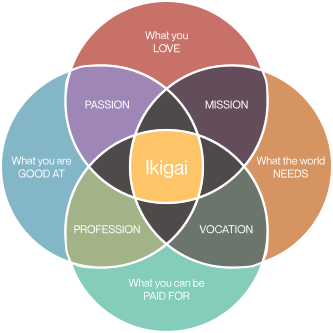
In the West, ikigai usually arrives as a diagram: four overlapping circles, one for each of four questions.
- What do you love?
- What are you good at?
- What can you be paid for?
- What does the world need?
Your ikigai, according to the theory, sits in the small patch at the center where all four circles overlap: work you love, that you’re good at, that somebody will pay you for, and that the world needs.
It’s a genuinely useful thing to sketch, and we use a version of it at MEA. But I’ve watched a lot of people fill in that diagram and walk away worse off, because they read it as an exam with one correct answer, which they are currently failing. They’ve read all the “how to find your passion” articles, and still they have no idea what they’re “supposed to be” doing.
First, remember that “what you love” is one circle out of four. “Follow your passion” mistakes a quarter of the picture for the whole thing. Passion is about what you feel. Purpose is about who it’s for.
Second, your answers to those four questions will change over time.
Dan Buettner of Blue Zones fame, who studied ikigai in Okinawa, notes that nobody’s focus stays fixed for life. What you love at 30 differs from what you love at 60. What you are good at deepens and narrows, and what the world needs from you changes as well. What you are willing to be paid for changes most of all, usually when you stop performing the definition of success handed to you in childhood.
The diagram is not an exam you pass; it’s a set of questions you answer repeatedly. Fill it in, act on what you wrote, and return to it when the answers stop feeling true.
If you’re waiting to feel certain before taking action, Herminia Ibarra at London Business School offers a realistic perspective. She spent decades watching people rebuild their working lives and concluded that you cannot discover yourself solely through introspection. You act your way into a new identity, and clarity follows.
Here is what that action looks like in practice.
Part 3
How to Live On Purpose
A warning about the heading below. This isn't a hunt for one true purpose waiting at the end like a prize. Everything below is small, repeatable and available this week – because living on purpose is a set of habits, not a destination.
How to Find Your Purpose in Life: Seven Practices That Worked for Me
You find your purpose by taking action, not by thinking harder. Start with these seven small practices.
Want to go further with these ideas?
Download Chip’s free eBook, Living & Working On Purpose
If you came here for the exercise that reveals your life’s purpose in a single afternoon, I don’t have one. I’d also be suspicious of anyone who says they do.
What I have is seven practices that reliably move people from thinking about purpose to living on purpose. All of them are small on purpose, because small is what gets done.
One research finding shaped this list.
In 2021, Nicholas Manco and Sherry Hamby analyzed 33 controlled trials [13] of programs designed to raise people’s sense of meaning and purpose. The strongest performers were narrative programs that asked people to put their life into words. Practices 1 and 5 below are built on that idea.
1. Find one person who will listen properly
When it comes to living on purpose, Leider warns that isolation is fatal. We’re not meant to do it alone. Leider recommends finding a “committed listener”: one person who can sit with you while you express two things out loud: what makes you come alive, and what is draining you that needs to end. Saying it out loud to one person is where isolation starts to lift.
Not only do your relationships help you live on purpose, they help you live healthier and longer. The Harvard Study of Adult Development has followed people since 1938 in the longest study of its kind ever run [14]. It found that the quality of close relationships predicts health and happiness better than money, class, or IQ.
Looking at participants at age 50, relationship satisfaction predicted health at 80 far better than cholesterol levels.
2. Ask what you’re willing to sacrifice.
Leider asks a straightforward question: “What am I willing to sacrifice? When you discover something you’re willing to sacrifice for, you know you’re onto your purpose.”
It’s a good filter. Wanting is easy. What you’d give something up for is what actually matters.
3. Excavate the gift, five times over.
Peter Drucker noted that the most important question any leader can ask is “what business are you in?” Applying this personally, ask yourself: what mastery or gift can you offer?
Have a friend ask you that question and answer with whatever comes to mind first. Have them ask again four more times, requiring a new answer each round. By the fifth round, you’ve run out of stock answers.
Or think about the last time you lost two hours without noticing. What were you doing?
4. Ask how you could be more useful, not how you could feel younger.
A colleague of mine hit a patch of feeling old and irrelevant and started thinking seriously about looking younger. I asked him instead who could use a little of his wisdom, and he was completely flummoxed by the question. Which I understood. Wisdom is far less tangible than wrinkles.
When I joined Airbnb at 52, I assumed they wanted my hospitality knowledge. What they actually valued was the people-wisdom I’d accumulated and never once considered as a skill.
Developmental psychologist Erik Erikson argued that the central task of the second half of life is generativity, or making and tending things that outlast you [15]. Its opposite is stagnation, the feeling of going through the motions without contributing beyond your own survival. If you keep your wisdom to yourself, it ends with you.
Being useful is how you stop being invisible. Start by asking: how can I serve?
5. Write the eulogy, not the résumé.
David Brooks distinguishes resume virtues, the achievements listed on a job application, from eulogy virtues, the qualities mentioned at a funeral, such as kindness, bravery, and meaningful relationships. Drawing on Rabbi Joseph Soloveitchik, Brooks argues that we need both held in balance.
I think each one matters most at a different stage. The first half of life builds the résumé. The second half builds the eulogy. And nobody tells you when the handover starts.
Raymond Jetson, MEA faculty and winner of the 2022 AARP Purpose Prize, wrote about his college professor Dr. Huel Perkins. Perkins brought immense enthusiasm to every class, explaining, “Every day I get to touch eternity,” knowing his students would pass that impact on to others.
Perkins’s résumé said Humanities professor. His eulogy is that a student still quotes him fifty years later.
Consider what you would want said about your life, and what actions you need to take this year to make that true.
6. Want less rather than get more.
Arthur Brooks noted that people who navigate the second half of life well share a common habit: wanting less. This can be challenging when you have the means to acquire more.
Every birthday, he writes a reverse bucket list: what he’ll stop doing, not what he wants to achieve. Writing your own list takes ten minutes and costs nothing.
7. Take the next right action, one day at a time.
In my podcast conversation with her, Elizabeth Gilbert, author of Eat Pray Love, mentioned that she no longer steers her life purely by desires. Instead, she borrowed two phrases from recovery programs: take the next right action, one day at a time.
Former U.S. Surgeon General Vivek Murthy notes that a fulfilling life relies on three core elements: relationships, service, and purpose [16].
Put that next to the three fears from the start: isolation, invisibility, loss of purpose. His prescription is their mirror image.
If you’d like to do this work with a small group, our Cultivating Purpose workshops run in Baja and Santa Fe. We also have online courses you can take from home.
Finding Your Purpose vs. Living On Purpose
The shift that matters most is moving from trying to find your purpose to living on purpose. I had to make this shift myself, and the table below shows how my thinking changed.
- You find your purpose
- It’s a noun you acquire
- One big Purpose, for life
- It’s on your business card
- You reflect your way there
- It arrives once you’re certain
- Feeling behind means you are
- Searching harder helps
- You live on purpose
- It’s a verb you practice
- A thousand small ones, revised
- It outlives your business card
- You act your way there
- Certainty arrives afterward
- Most of us have felt purpose anxiety
- Searching harder hurts
If you recognize yourself on the left, you’re not behind. That’s where I was at 47, and where most people are the first time they type “how do I find my purpose” into a search bar.
The right-hand column isn’t a destination you arrive at. It’s a different way of holding the question – without waiting for an answer.
Part 4
Living With Purpose: What It Looks Like
Three people who rebuilt how they live rather than locating a single answer. Then the smallest possible first step, and the questions I get asked most.
Life Purpose Examples:
Three People Who Found Theirs in Midlife
Most purposes are smaller than people expect. A few life purpose examples:
- Mentoring the new hire
- Coaching your town's Little League team
- Being the friend everyone calls in a crisis
- Teaching the neighbor's kid to read
- Taking care of your grandchildren or your garden
None of these would fit on a business card, and all of them count.
Blake Mycoskie, Arthur Brooks, and Elizabeth Gilbert all rebuilt their sense of purpose in midlife, and none of them did it by working out a purpose first.
Here’s how each of them did it.
The one who tried to buy his way out. Blake Mycoskie built TOMS, the shoe company that gave a pair away for every pair sold, then exited and moved to his dream house in the mountains outside Jackson Hole.
And then he came apart. With no team, no community, and nothing to show up for, he was miserable.
So he tried to spend his way out of his unhappiness. He bought an extravagant house. Ridiculous vacations, classic car collection – none of it worked.
What eventually helped was smaller, and cost nothing. Someone handed him a string of beads and a single sentence to repeat – I am enough, I’ve always been enough – twenty minutes in the morning and twenty before bed, for forty days.
Underneath everything, he’d held a lifelong belief that he wasn’t enough, and no quantity of houses or cars or career success had come close to touching it.
Mycoskie now makes bracelets carrying that sentence and works to get them into high schools, because he believes that knowing your own worth matters more for mental health than anything money can buy.
The one who walked away at the top. Arthur Brooks had run the American Enterprise Institute – the Washington think tank – for a decade when he decided to leave. People told him he was making the worst mistake of his life. He’d never have that influence again, or that money.
He told me about sitting on a plane out of Dubai, praying – Lord, I’m so afraid – then catching himself. Afraid of what, exactly? Of no longer being the president of a think tank. He’d flown halfway round the world to hear how absurd that sounded.
What made him good at the job was never the title. It was his ability to spot patterns and explain them, and that came with him.
He moved into teaching at Harvard in 2019, and later wrote From Strength to Strength about this kind of second-act transition.
Most of the time, finding your purpose means recognizing what you were already doing.
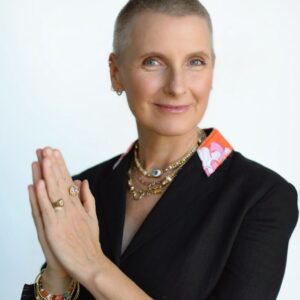
The one who stopped steering. Elizabeth Gilbert built a life on wanting things and being very good at getting them. Then she decided she’d been a poor judge of what would make her happy, and stopped making decisions based on what she wanted.
Six years later, she told me it had been the most creative stretch of her entire life. In that time, she wrote three books, deepened her friendships and came off every medication she’d been on. She now describes herself as someone who “came here to love and to serve other human beings.”
Notice what none of these three people did. Nobody sat down and worked out their life purpose. They started intentionally living in it – and it took shape as they went.
Three Routes Through

Blake Mycoskie
The one who tried to buy his way out
1What ended
He sold TOMS
2What he found out
Money couldn’t touch it
3What he does now
Gets “I am enough” bracelets into high schools

Arthur Brooks
The one who walked away at the top
1What ended
He left the think tank
2What he found out
What made me great isn’t my future
3What he does now
Teaches, and writes a stop-doing list every birthday
Elizabeth Gilbert
The one who stopped steering
1What ended
She stopped steering by what she wanted
2What she found out
I was a poor judge of my own happiness
3What she does now
Asks who she’s for
Three different routes. Not one of them started by working out a purpose.
What Should I Do With My Life?
Four Ways to Start This Week
If you’re asking “What should I do with my life?”, you don’t need the whole answer yet. Start small this week: text one person, have a friend ask you the gift question five times, write a list of what you’ll stop doing, and help one person.
Everything above narrows to four things you could do in the next few days.
Start this week
Four Things to Do Before Sunday
-
1
Text one person
Ask for an hour to say out loud what makes you come alive, and what’s draining you.
2 minutes -
2
The gift question, five times
“What mastery or gift can you offer?” Answer fast. No repeats.
20 minutesNeeds a friend -
3
Write your reverse bucket list
Not what you want to do this year. What you intend to stop.
10 minutes -
4
Be useful to one person
Once, small, expecting nothing back. Notice what it does to your day.
Today
Total cost: nothing.
meawisdom.com
As psychiatrist David Viscott put it: discover your gift, develop it, give it away. And remember, living on purpose always involves other people. Make time for the relationships and communities where you can put your gifts to use. They’re often the ones who notice what you’re good at before you do.
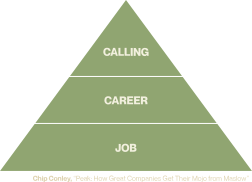
If you’d like to do this work with others, join one of our Cultivating Purpose workshops. And for more on the ideas in this article, including ikigai and the difference between a job, a career and a calling, download our free guide, Living & Working On Purpose.
If you have questions or you want to explore other workshops, please feel free to connect with an advisor for a complimentary one-on-one session.
FAQs
What is the purpose of life?
Philosophically, nobody agrees. Practically, purpose is a reason to get up – an aim that organizes your choices and points at somebody other than you. It doesn't have to be grand, permanent or singular, and treating it as all three is what makes people miserable.
What is my purpose in life?
Nobody can hand you that answer, and it's rarely a single sentence. Start with what people already come to you for and thank you for. That's your small "p" purpose, and it's usually closer than you think. Act on it, and the bigger picture tends to follow.
What's the difference between purpose and meaning?
Nobody can hand you that answer, and it's rarely a single sentence. Start with what people already come to you for and thank you for. That's your small "p" purpose, and it's usually closer than you think. Act on it, and the bigger picture tends to follow.
What if I can't find my purpose?
Nobody can hand you that answer, and it's rarely a single sentence. Start with what people already come to you for and thank you for. That's your small "p" purpose, and it's usually closer than you think. Act on it, and the bigger picture tends to follow.
Is it too late to find your purpose at 50? At 60? At 70?
No, and the research is clear. In the MIDUS study, the longevity benefit of purpose didn't depend on age or on whether people had already retired. Richard Leider has written 11 books on purpose and is still teaching in his 80s.
How do I find purpose after retirement?
No, and the research is clear. In the MIDUS study, the longevity benefit of purpose didn't depend on age or on whether people had already retired. Richard Leider has written 11 books on purpose and is still teaching in his 80s.
Can your purpose change?
Yes, and it's supposed to. What you love at 30 isn't what you love at 60, and what the world needs from you changes entirely. If yours hasn't shifted in twenty years, that's worth examining.
What's the difference between purpose and passion?
Passion is what you feel. Purpose is who it's for. Following your passion turns you inward at exactly the moment the evidence says outward works – and it's loudest about things you already know you like.
Is ikigai the same as purpose?
Roughly, though the Japanese concept is smaller and more everyday than the four-circle diagram suggests. Someone's ikigai might be their grandchildren or their garden. It isn't necessarily your job, and it isn't necessarily impressive.
What's the difference between a job, a career and a calling?
A job pays the bills. A career brings recognition. A calling is work you'd find a reason to do anyway. The difference isn't the work – it's what you bring to it. I've met miserable philanthropists and purposeful plumbers.
About the Author
Chip Conley
MEA Co-Founder and Author of Learning to Love Midlife: 12 Reasons Why Life Gets Better with Age
A three-time TED speaker on the big stage, Chip Conley is one of the world’s leading experts at the intersection of business innovation, psychology and spirituality.
As one of the creators of the boutique hotel movement and the “modern elder” to the young Airbnb founders, Chip’s been a disruptor and expert on entrepreneurship and business leadership. He’s a globally-recognized thought leader on the future of work and the competitive advantages of a multi-generational workplace.
Inspired by his experience of intergenerational mentoring as a “modern elder” at Airbnb – where his guidance was instrumental to the company’s extraordinary success – Chip founded MEA and has since dedicated his midlife years to reframing the concept of aging and helping people navigate midlife with a renewed sense of purpose and possibility.
Sources & Further Reading
- Rainey, L. (2014). The Search for Purpose in Life. MAPP capstone, University of Pennsylvania.
- Skerrett, K., Spira, M. & Chandy, J. (2022). Emerging Elderhood: Transitions from Midlife. Clinical Social Work Journal, 50(4), 377–386.
- Damon, W., Menon, J. & Bronk, K. C. (2003). The development of purpose during adolescence. Applied Developmental Science, 7(3), 119–128.
- Ryff, C. & Keyes, C. (1995). The structure of psychological well-being revisited. Journal of Personality and Social Psychology.
- Steger, M., Frazier, P., Oishi, S. & Kaler, M. (2006). The Meaning in Life Questionnaire. Journal of Counseling Psychology.
- Crumbaugh, J. (1977). Seeking of Noetic Goals Test.
- Hill, P. & Turiano, N. (2014). Purpose in life as a predictor of mortality across adulthood. Psychological Science (MIDUS).
- Alimujiang, A. et al. (2019). Association between life purpose and mortality among US adults older than 50. JAMA Network Open.
- Sutin, A., Luchetti, M. & Terracciano, A. (2021). Sense of purpose and healthier cognitive ageing. Trends in Cognitive Sciences.
- Martela, F. et al. (2024). Which predicts longevity better: satisfaction with life or purpose in life? Psychology and Aging.
- Pinquart, M. (2002). Creating and maintaining purpose in life in old age. Ageing International.
- Steger, M., Kashdan, T. & Oishi, S. (2008). Being good by doing good: daily eudaimonic activity and well-being. Journal of Research in Personality.
- Manco, N. & Hamby, S. (2021). A meta-analytic review of interventions that promote meaning in life. American Journal of Health Promotion, 35(6), 866–873.
- The Harvard Study of Adult Development, directed by Robert Waldinger, Harvard Medical School.
- Erikson, E. on generativity and stagnation as the central tension of midlife.
- Murthy, V. Together.
- Martela, F. & Steger, M. F. (2016). The three meanings of meaning in life: Distinguishing coherence, purpose, and significance. The Journal of Positive Psychology, 11(5), 531–545.
Further reading: Kashdan, T. & Steger, M. (2007). Curiosity and pathways to well-being and meaning in life: Traits, states, and everyday behaviors. Motivation and Emotion.