

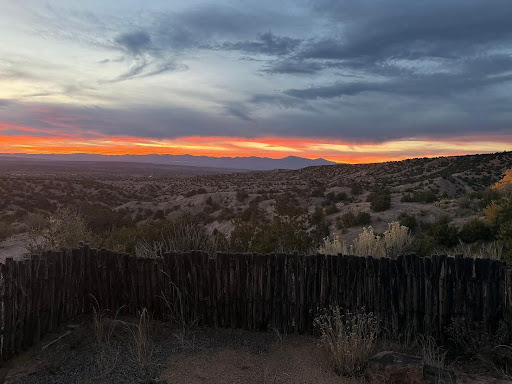
D.H. Lawrence’s views survive. Charles R. Wolfe photo
I think that New Mexico was the greatest experience from the outside world that I have ever had. It certainly changed me forever…the moment I saw the brilliant, proud morning shine high up over the deserts of Santa Fe, something stood still in my soul, and I started to attend.
—D.H. Lawrence, 1928
I am trying to remember the exact moment that I decided to move to New Mexico.
It could have happened while I was in the village of Villanueva, near the Pecos River, or when I first drove north from Española towards Abiquiú, or as I crossed the Rio Grande Gorge near Taos. But, no matter when or where the decision occurred, I know it was during an episode of enhanced presence. In those moments, I understood that the land and light were telling me a story that was, at first, incomplete, and that I would not fully understand what I saw without longer-term, patient, and ongoing immersion.
So began the last 18 months, during which my dedicated explorations, introductions, and attempts to remain humble have defined the day-to-day.
When I unravel my move to New Mexico, I remember exploratory steps and then a leap towards change, leaving behind professional experiences and personal challenges.
I also recall trying to make the move something less than impulsive. Residual parental voices demanded wise decisions and only the best of outcomes. To my delight, New Mexico’s raw materials quickly upended any such imaginary expectations.
When I was three-quarters of the way through the move, I attended a MEA workshop in the Galisteo Basin, co-led by Chip and my favorite author, Pico Iyer. This opportunity was a happy coincidence, as I was already nearby. The New Mexico landscape surrounding MEA’s Rising Circle Ranch amplified the experience, showcasing the kind of environmental exposures once worthy of D.H. Lawrence’s call towards presence quoted above.
During a group conversation about life’s crossroads, Pico recounted his well-known realization at age 29: that, after an unexpected overnight stay near Narita Airport while on assignment for Time Magazine, he found an indelible connection to Japan that he knew would never fully unfold unless he moved there.
I was struck by more than the story—which I had read about before—because, as the week went on, Pico’s in-person musings merged with electric storms at night against the silhouettes of the Sangre de Cristo mountains. Together, they spun threads of inevitability towards committing to New Mexico and a focused attention on a new home.
I half-joked to my workshop cohort that my fate was now to “be Pico at 29,” meaning, of course, that I had discovered the presence to follow a life that was already opening in front of me.
But the more profound lessons about both presence and patience began only after the move was complete, a few weeks later in Santa Fe.
Eventually, seven lessons matured. They suggest that, however compelling the concept of inevitability might be, an intentional approach offsets most gaps in confidence, the lure of immediate gratification, or illusions of instant belonging.
Lesson 1: Presence requires honest admissions about who and where you are.
Santa Fe supplied few void-filling or medicating distractions, such as deadlines, a sense of urgency, or others’ expectations. Presence became much less about fearing judgments by new people in unfamiliar places; it began with listening to my own reactions and learning to acknowledge them without descending into self-critical panic. Learning from Pico’s work, stillness became a go-to and a restorative safe harbor.
Lesson 2: The land speaks through purposeful immersion.
Previously, in many cities and in my written work, I had learned to read and analyze urban forms and “character,” such as buildings and streets, and the cultures that stand behind them. In contrast, New Mexico demands immediate attention to landforms, the sky, and the horizon. My new habits include watching the Jemez Mountains and Valles Caldera at dusk (as shown above), becoming all too familiar with adobe tones, and marveling at water’s routes after rain. A sensory reaction usually precedes any intellectual response.
Lesson 3: Belonging demands patience.
I have also learned that New Mexico—even with friendships and professional affiliations already in place—does not rush relationships. People here look for eye contact, consistency, and respect before they look at résumés. Regardless of cultural background, whether indigenous, Hispano, or Anglo, the trend line is clear. People want to know if you will be staying and showing up regularly rather than leaving when your lease expires. Patience here is more than waiting for friendships to mature. Patience requires learning how to demonstrate commitment and to remain consistent over time.
Lesson 4: Observation and presence improve with repetition.
Some of my most meaningful experiences since June 2024 have come from traveling the same routes repeatedly at different times: Whether the classic Santa Fe experiences of Canyon Road, the Plaza, the Acequia Madre, navigating the quirky parking lot at Trader Joe’s, or negotiating the sprawl and traffic of Cerrillos Road. Each journey reveals new textures, points of view, issues, and stakeholders. Belonging grows with repeated exposures that spur varied perspectives.
Lesson 5: Participation requires humility.
Presence in New Mexico is more a discipline of listening than speaking, of becoming a student again. A year ago, I wrote about the importance of being a “humble newbie,” and only recently have I begun to project past experiences from elsewhere through activities like a published op-ed in the New Mexican.
I may have arrived with expertise in land-use law, planning, writing, and global urban observation. But none of that directly resonates in Santa Fe or New Mexico before proving up the answer to the operative question: Am I here to belong or to impose an ego from afar?
Lesson 6: Finding purpose is easier with less urgency.
Immediately after arrival, nervous energy made me eager to contribute—to provide insights, offer ideas, share my photography, and champion Santa Fe and New Mexico as part of my ongoing “leveraging place” work. However, the more I showed up with any sense of urgency, the more the place seemed to push back and obscure clearer paths. I have learned that presence and purpose in New Mexico benefit from immersive practices rather than promotion, such as walking, noticing, conversing, and, sometimes, just slowing down and waiting.
Lesson 7: Transformation seems slow until a sudden shift sets in.
Something happened a few months ago—I don’t remember the exact date, but my months of mindfulness seemed to blend with my surroundings, and I was no longer arriving. I was living here, in what I called “the place beyond the brand.” As this sensation of arrival continues, I identify even further with Pico at 29, and feel increasingly confident that we can gain coherence—regardless of age—if presence and patience remain at our side.
Barbara Waxman and Chip Conley both imply that the path through “middlescence” offers a longer, slower, and wiser transition than the more awkward journey through adolescence. I suppose New Mexico has been my middlescence teacher—showing how the land, the light, the people, and the pace of life invite us to participate with grace rather than experience our surroundings only through detached description.
-Chuck
Chuck R. Wolfe is an MEA alum, a recovering lawyer, and now an author, photographer, and part-time academic who writes about cities and places (you can learn more in his three books and his most recent project is the Substack).