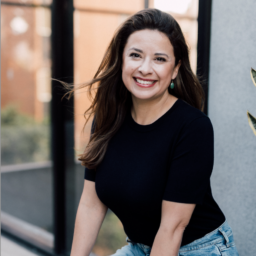
Carolina has become an insightful teacher in our MEA Purpose Fellowship as well as in other MEA workshops. She’s one of the new generation of thought leaders on the topic of purpose so I think you’ll enjoy her guest post today.
The preposition that changes your life’s purpose
“What is the meaning of my life?”
As a purpose mentor and teacher, I hear that question a lot. And before diving in to provide any type of answer to such a deep inquiry, I invite my clients and retreat participants to explore a deceptively simple shift: change the preposition.
How about going from of to in, changing the question to “What is the meaning IN my life,” instead?
In essence, asking yourself:
- What gives meaning to my day-to-day life?
- What sources of meaning might I be able to cultivate more deeply?
- What feels meaningful in my life, as it is, today?
Did you notice an inner shift as you read those new statements?
Most people do.
That one-word adjustment changes all of its, well, meaning (pun intended).
What happens is that when we talk about the meaning OF life, the question feels really big. One that philosophers, mystics, and seekers have wrestled with for centuries. It points to something ultimate, something that can even sound predetermined or simply unattainable. It implies there is a correct answer somewhere out there, and that until we find it, we are somehow incomplete.
The meaning IN life feels different. Closer. More intimate. More forgiving. More attainable. It doesn’t ask us to solve a super hard equation. It invites us to participate in an exploration. To notice, to choose, to pay attention to what is already present in the way we move through our days.
I’ve asked myself both versions of this question many times throughout my life. And I can say that I’ve actually obsessed over these questions for the past decade.
Years ago, while working in Silicon Valley, I found myself quietly wondering about the meaning of my existence. On paper, I had everything I thought I wanted: a strong career, titles, diplomas, a solid path forward. And yet, something didn’t feel fully right. Not dramatically wrong, just not fully alive. The word that came closest to describing it was emptiness. An absence of something I didn’t yet know how to name.
And it had a deep impact, slowly making me more serious, apathetic, and disengaged. I became disinterested in life in general.
All of those emotions led me to take action. So, I went searching. I packed a suitcase and traveled alone around the world, learning from different cultures, ancestral wisdom, and teachers, trying to find the answer to my big questions.
What I found didn’t arrive as a single defining moment or a clear, holdable truth. It came in layers. And looking back, I can trace it through three main distinct shifts. What I now call the three A’s.
Awareness
The first one was simply learning to pause and notice. Being in unfamiliar places brought me back into my body in a way I hadn’t experienced in months. I began to see how often I had been operating on autopilot, completing endless to-do lists, moving quickly, thinking ahead, rarely pausing long enough to actually feel my life as it unfolded.
While living in a monastery in India, the space invited me to deepen my awareness and truly observe what was really happening beneath the surface: to name my own emotions, and to hear what they were trying to tell me. It changed my relationship to my own moment-to-moment experience in ways I hadn’t anticipated.
The questions awareness invited me to explore were: How am I really (really) doing? What’s behind these emotions? What are they trying to tell me?
Aliveness
From that presence, something else opened. I started to more authentically explore what makes me feel fully alive.
Not productive. Not successful. Not impressive. Not from following externally imposed “shoulds.” Just truly alive.
And the answers surprised me. They were rarely the things I had been chasing. They were smaller, more immediate, more joyful activities, such as cooking a meal slowly, creating something with my hands, getting lost in a conversation, researching a topic I was fascinated by, writing about the topics I loved, and going back to oil painting… Moments where I wasn’t performing or achieving, just genuinely, fully present in the pleasure of being here.
I reconnected with enthusiasm, a word I love from the Greek en + theos: to be filled with something greater than yourself, something divine. Enthusiasm doesn’t just feel good, but provides direction with ease and another, almost spiritual, level of inspiration.
The questions aliveness poses are, What makes me feel genuinely alive? What brings me joy without needing to be justified? What would I do more of if I stopped waiting for permission?
Alignment
And then, gradually, came alignment. Not as a bold declaration, but as a series of small, authentic choices. Tiny adjustments in how I spent my time, what I said yes to, and how I embraced what I could no longer ignore.
Small alignment steps eventually led me to take bolder actions, such as leaving my corporate career to join a nonprofit that focused on mindfulness. That was a decision that didn’t feel comfortable for my ego back then, but felt unmistakably right for my heart.
The questions alignment invites us to explore include, What decision feels like a full yes, internally? What path is truly coherent with my values and intentions? What small action can I take to deepen my alignment, just a little more?
What I’ve come to understand, and I now share with everyone I work with, is this: the meaning OF life is solved by cultivating meaning IN life. The meaning of life is the sum of day-to-day moments that bring a sense of meaning in our lives.
Each moment of awareness, each flash of aliveness, and each small act of alignment to our truth, brings us closer to our own unique way of connecting to a greater sense of meaning, again and again.
And that’s how the big question is answered, one day at a time.
-Carolina
Carolina Lasso is a purpose and human flourishing mentor, teacher, MEA alum and faculty member, and thought leader. She’s the author of “The Path to Flourishing,” co-author of “The Purpose Reset,” and creator of the PlenaMente podcast.