

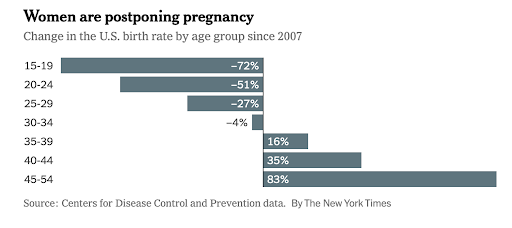
I read this recent New York Times piece about declining birthrates, and what struck me wasn’t just that fewer babies are being born—it’s who is (and isn’t) having them.
Births are dropping fastest among younger women, while older mothers—those in their 30s and even early 40s—are becoming a bigger share of all births.
In other words, it’s not that people don’t want kids. It’s that they’re waiting. And waiting. And… sometimes deciding not to.
The cultural script has flipped. What used to be “early adulthood = family” is now more like:
early adulthood = figuring out if adulthood is even affordable.
Financial stability, career identity, emotional readiness—these aren’t luxuries anymore; they feel like prerequisites. And so parenthood becomes less of a default and more of a conscious, sometimes postponed, choice.
Here’s my take: We’re not witnessing a collapse of family. We’re witnessing a renegotiation of timing and meaning.
But there’s a shadow side.
Biology still runs on an older timeline. Fertility declines with age, even as our readiness increases.
So modern life creates a quiet tension: We become more prepared for children… just as it becomes harder to have them.
Maybe the deeper question isn’t “Why are births declining?”
Maybe it’s this: Have we designed a world where becoming an adult—and becoming a parent—are now in conflict with each other?
And if so, that’s not just a demographic issue.
That’s a design flaw.
-Chip